

When people talk about mobile apps, they often jump straight to big outcomes: downloads, virality, retention, revenue, scale.
But in the early stage, growth is much quieter than that.
It is less about “going viral” and more about learning how users discover you, what makes them pay attention, and what gives them enough confidence to install your product in the first place.
That is where we are right now with Space App.
As we continue building Space App, Apple’s analytics tools have started giving us something very valuable: not just numbers, but signals. Signals about user behavior, product positioning, app store performance, and where we still need help.
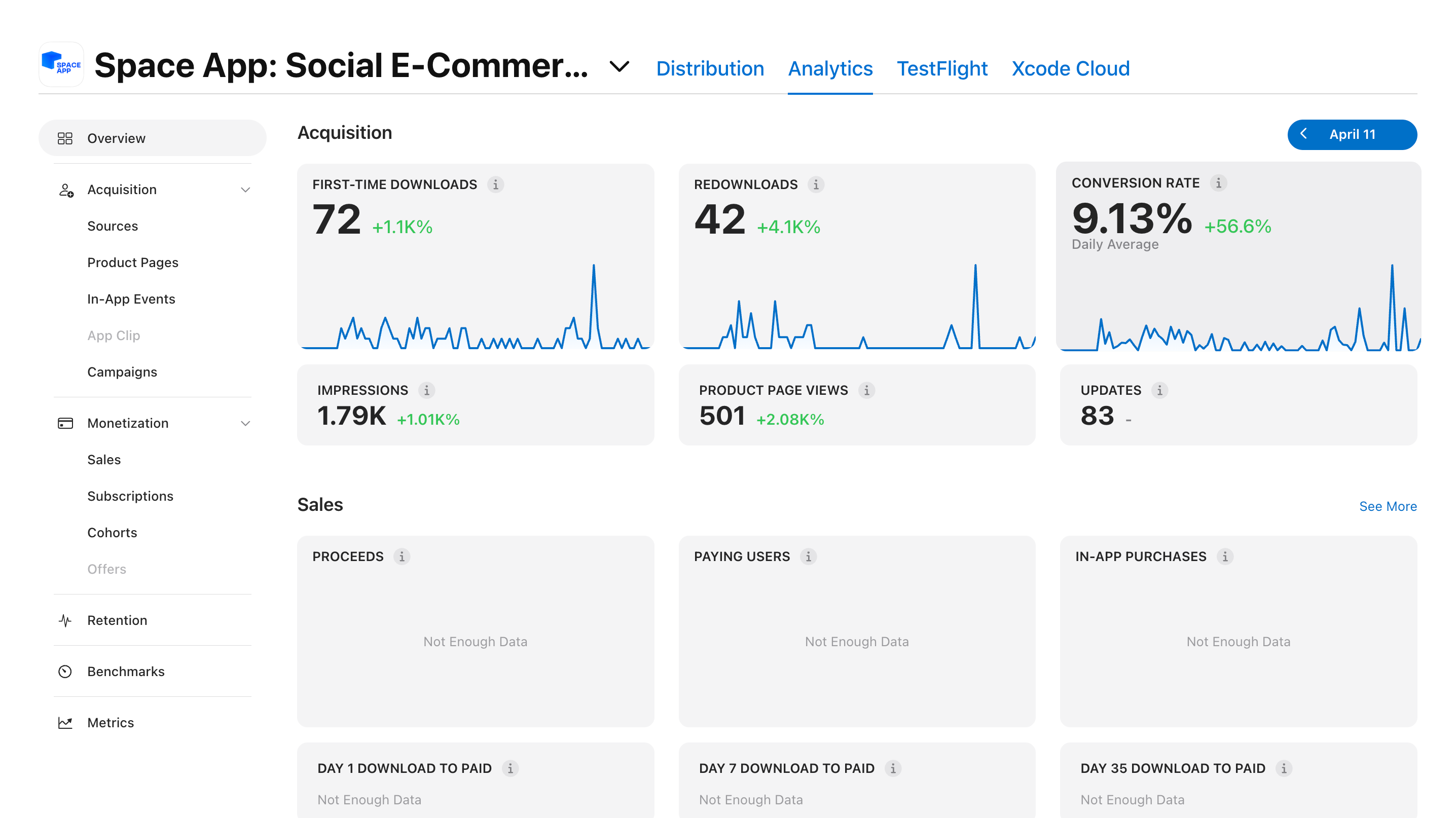
From our current Apple analytics, we are seeing:
1.79K impressions
501 product page views
72 first-time downloads
42 redownloads
9.13% conversion rate
These numbers are still early, but they are already teaching us important lessons about mobile app acquisition.
Why Apple Analytics matters more than many founders realize
A lot of founders treat analytics as something you look at after growth starts happening.
I am starting to think the opposite.
Analytics is not just for reporting results. It is for shaping decisions.
Before spending more on ads, partnerships, or influencer campaigns, it helps to understand what is already happening inside the funnel:
Are people discovering the app?
Are they interested enough to click?
Are they converting once they land on the page?
Is the issue visibility, positioning, or trust?
Apple analytics helps break that down.
That matters because in mobile, poor growth is not always a traffic problem. Sometimes it is a message problem. Sometimes it is a product page problem. Sometimes it is a user expectation problem. And sometimes it is simply that the app has not yet communicated its value clearly enough.
A simple way to think about user acquisition
One of the clearest lessons we are learning is that user acquisition is not one event. It is a chain of decisions.
A user does not just “download an app.”
They move through stages:
1. Discovery
This is where impressions happen.
Someone sees your app in search, browsing, recommendations, or through external traffic. If impressions are growing, it means visibility exists. That is the first signal.
For us, rising impressions suggest that Space App is beginning to get seen.
2. Consideration
This is where product page views matter.
A user saw the app and decided to learn more. That means something about the app name, icon, category, or context was strong enough to earn a click.
This is an underrated stage. Many products never even make it here in a meaningful way.
3. Conversion
This is where downloads happen.
The user lands on the page and makes a judgment:
Does this app look useful?
Do I understand what it does?
Do I trust it enough to try it?
That is why conversion rate is such an important number. It reflects how well your positioning, screenshots, copy, and product promise are working together.
For Space App, the current 9.13% conversion rate is encouraging. It tells us that once some users reach the page, there is meaningful interest. But it also tells us there is room to improve the system around it.
What these early numbers are teaching us
The biggest lesson so far is that growth is not only about getting more people to the app page.
It is also about making sure the app page does a better job converting attention into action.
That means asking harder questions:
Do our screenshots explain the product clearly enough?
Is our value proposition instantly understandable?
Are we speaking like builders and insiders, or like users?
Are we showing outcomes, or just features?
Does a first-time visitor know who the app is for?
These are not branding questions alone. They are acquisition questions.
In mobile, even a good product can struggle if its first impression is weak.
The challenge with a product like Space App
Space App is not a single-purpose utility app. It is a broader ecosystem that sits at the intersection of commerce, creators, and technology.
That makes it exciting, but it also makes positioning harder.
When a product serves buyers, sellers, creators, and brands, the challenge is not only building the experience. The challenge is making the value legible in seconds.
A user on the App Store is not reading a pitch deck. They are scanning quickly.
So a major part of our work right now is translating a broad vision into something simple, immediate, and compelling.
That is one reason Apple analytics has been helpful. It forces clarity. It shows whether the market is understanding what we think we are communicating.
What I think more founders should pay attention to
If I had to pull one practical lesson from this stage, it would be this:
Do not wait until later to take acquisition seriously.
Acquisition does not start with ads. It starts with understanding:
how people discover your app,
what makes them click,
what makes them trust,
and what makes them convert.
That is true whether you are building a fintech app, marketplace, creator platform, or productivity tool.
The earlier you learn how users move through that funnel, the better your decisions become.
Where we still need help
This is also where I want to be transparent.
We are learning a lot, but we also know we would benefit from support from people who have done this before.
We are especially interested in hearing from people with experience in:
App Store Optimization (ASO)
mobile growth strategy
consumer marketplace apps
creator-led user acquisition
product page optimization
early-stage app analytics and conversion improvement
If you have built, scaled, advised, or worked on mobile apps and have thoughts on how to improve acquisition, conversion, or positioning, I would genuinely love to hear from you.
Not because we are looking for generic advice, but because we are in that stage where the right insight can save months of guesswork.
We are also open to support from:
growth advisors
product marketers
mobile app strategists
early collaborators
potential partners who understand consumer mobile ecosystems
Why I am sharing this publicly
I think more founders should talk honestly about this stage.
Not just the wins, but the interpretation behind the numbers.
There is a lot of pressure in startup culture to perform certainty. But the truth is, building a mobile product is often a process of learning in public, refining in public, and asking better questions in public.
That is what we are doing with Space App.
We are paying attention to the data, learning from each signal, and trying to build a stronger acquisition engine one layer at a time.
And as we do that, I want this Substack to be a place where I document what we are learning, what is working, what is not, and where help from others can genuinely make a difference.
If you are working on similar problems, or if you have experience in mobile growth and acquisition, I would be glad to connect.
Because sometimes the most important thing analytics gives you is not certainty.
It gives you direction.