They talk about innovation, digital transformation, custom software, platforms, AI, and end-to-end solutions. The language is polished, but too often it is also vague. It tells you that they build things, but not what they actually understand.
Over time, I’ve realized that if Kspace is going to grow into a serious company, our positioning has to be more disciplined than that.
We cannot just be “a software company.”
We cannot just be “a technology company.”
And we definitely cannot be another firm that says it can do everything.
So the real question became: what kind of problems do we want to be known for solving?
The more we worked through that question, the clearer the answer became.
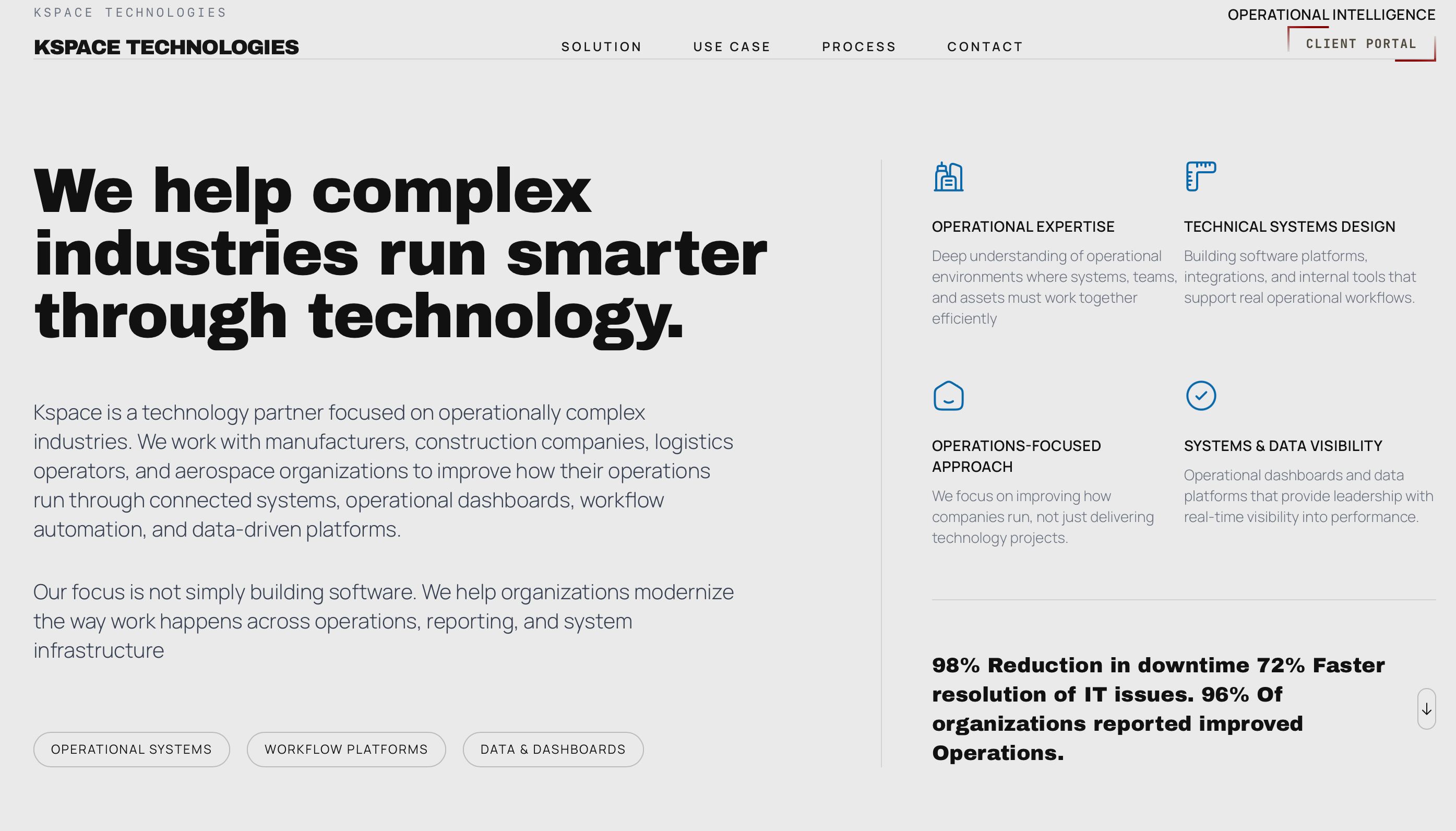
Kspace is a technology partner for operationally complex industries.
That means we want to focus on sectors like manufacturing, logistics and transportation, and aerospace and space technologies.
At first glance, those industries may look different. But operationally, they are much closer than they seem.
They all depend on systems that must work together reliably. They all involve expensive assets, multiple teams, and workflows where delays or mistakes carry real cost. They all suffer when data is fragmented, coordination is manual, and leadership lacks visibility into what is actually happening.
That shared reality is what connects them.
The problem is rarely “lack of software”
One thing I think the market often gets wrong is assuming companies need more software.
Most companies do not wake up and say, “We need another platform.”
What they feel is something else:
decisions are taking too long
teams are relying on spreadsheets and workarounds
reports are delayed or inconsistent
systems do not talk to each other
managers do not have a clear real-time view of operations
problems are identified too late
In other words, the problem is not the absence of technology.
The problem is the absence of operational clarity.
And once you start viewing it that way, the role of Kspace becomes much more specific.
We are not just building tools.
We are helping companies improve how they run.
That may result in dashboards. It may result in workflow systems. It may result in automation, integrations, internal platforms, or data infrastructure. But those are outputs. The actual value is operational performance.
Why these industries make sense together
There is a temptation when choosing industries to simply chase where the money is. But that creates shallow positioning.
The better approach is to ask where your thinking naturally fits.
Manufacturing, logistics, and aerospace all live inside environments where operational complexity is unavoidable.
In manufacturing, that complexity shows up in production workflows, downtime, quality issues, reporting delays, and coordination between teams.
In logistics, it shows up in dispatch, fleet visibility, warehouse operations, service coordination, and the constant need for accurate timing and communication.
In aerospace and space technologies, it appears in even more technical forms: precision, reliability, system traceability, internal process control, and data-driven decision-making.
What links these industries is not just that they use technology.
It is that better systems directly improve execution.
That is where Kspace belongs.
Why manufacturing is the right place to start
Even though Kspace has a natural brand alignment with aerospace and space technologies, manufacturing is probably the strongest first market for us.
That is because manufacturing pain is easier to see and quantify.
If production visibility is weak, it shows up.
If reporting is delayed, it shows up.
If manual coordination creates inefficiency, it shows up.
If workflows are broken, the financial effect is easier to connect to reality.
That makes manufacturing a strong first proving ground. It gives us a market where operational problems are concrete, where better systems have obvious value, and where a solution like OIP can enter naturally.
It also creates a bridge into logistics and aerospace later.
The way we want to engage clients
Another important realization is that Kspace should not lead with “custom software development.”
That sounds too broad, and it places the buying burden on the client too early.
A better approach is to lead with diagnosis.
That means starting with things like:
Operational Visibility Reviews
Production Reporting Audits
Workflow Bottleneck Mapping
Dispatch Visibility Reviews
Operational Data Readiness Assessments
This is important because operational buyers are not usually looking to “buy software.” They are looking to solve a problem. Diagnosis helps define that problem clearly, build trust, and create a rational path toward implementation.
In that sense, our entry offer is not really software. It is clarity.
What delivery should feel like
If Kspace is going to position itself seriously, then delivery also has to feel serious.
Clients do not want vague timelines or endless discovery without outcomes. They want a clear sense of what happens when they engage, how long it will take, and what they will receive.
That is why I believe our delivery framework should stay simple and credible:
Phase 1: Operational Discovery
Understand workflows, systems, bottlenecks, reporting gaps, and operational pain points.
Phase 2: Systems Architecture & Solution Blueprint
Design the dashboards, automations, integrations, and data structure required.
Phase 3: Platform Development & Integration
Build the operational systems and connect fragmented environments.
Phase 4: Deployment & Operational Intelligence
Launch, onboard teams, and establish a more visible, data-driven operating environment.
A typical delivery timeline of roughly 10–12 weeks gives the client something powerful: confidence that improvement can begin within 90 days.
That matters.
What Kspace is not trying to be
Sometimes the clearest positioning comes from saying what you are not.
Kspace is not trying to be:
a simple web design shop
a generic software outsourcing firm
a low-cost development agency
a company for businesses that have no operational complexity
We are building for businesses where operations matter deeply, where systems affect performance, and where fragmented workflows are slowing growth or execution.
That is a narrower space, but a stronger one.
The simplest truth
The simplest expression of all this is still the strongest:
We solve operational problems with technology.
Everything else expands from there.
It shapes who we target.
It shapes how we speak.
It shapes what we build.
And it gives Kspace a real point of view.
That matters because the companies we want to serve do not need more noise. They need partners who understand what operational complexity actually feels like.
That is the direction we’re building toward